Showing posts with label Religion. Show all posts

2010-09-08

Hainan China

Girlwing, her parents and I went for a eight days vacation to Sanya on the island Hainan, which is a tropical island south of China. Hainan is famous for its beautiful beaches, fancy hotels, pretty seashells, tasty seafood, giant Guan Yin (观音) and sweet coconut candies.

To the left you can see the first hotel we stayed at. GuestHouse International Hotel in Sanya is quite fancy with a great view from the top of the mountain and not too far from the beach. We payed around 400 yuan per night for a room.

The Guesthouse by night.

This little friend was waiting outside our hotel room one morning.

One day we went to NanTian Hot Springs outdoor spa. There they have fish that feed on visitors. They like exotic Swedish flesh.

Another day we went to see the giant GuanYin. On the way there we stumbled over some ancient grafitti. This one say longevity (长寿).

Here you can read "Live long and prosper" (寿无量).

These are common in temples and used for praying.

The entrance to the temple. Over the entrance you can see "二不" which should be read from right to left and literally means "not two". I leave it as your homework to figure out the deeper meaning of that.

The goal to our journey. A view of the giant Guan Yin.

Guan Yin again.

Next day we spent some time in the town and I found several interesting things to take pictures on. This is some strange tea.

When it is hot and the sun stands high, you should protect your skin from the strong sun.

Selling narcotics.

Need a copy of a key?

Or maybe buy some second handed shoes?

Here we are selling meatballs, fish balls and other kind of balls cooked in oil on a stick. To the right they sell lemonade.

In Hainan you can buy all kinds of fruit for really great prices.

Fruits are sold everywhere.

Lottery is the weeks highlight.

Selling more drugs.

A dried fish store.

An ice cold soup made of fruits like watermelon, sweet potatoes, cocnut, beans and some more stuff mixed with coconut milk and ice.

A lotus flower in a pond in the hotel area of the second hotel we stayed at.

Our bedroom in the more fancy Crowne Plaza in Sanya.

The hotel beach.

The hotel beach.

They serve drinks as well. Nice :)

This is the hotel area where we borrowed a tandem bike.

The Crowne Plaza is a really big hotel. This is just the hotel lobby. Second floor is housing a café. I like the ancient style. The hotel were the location for the miss world the same year we where there, but earlier.

2010-08-20

Xi'An Giant Wild Goose Pagoda

I earlier wrote that we saw the Small wild goose pagoda. If there exist a Giant wild goose pagoda, then we must go see that one too!

We went there quite late when the sun was setting, with heavy clouds and a light rain, so I did not have the optimum conditions to take good outdoor pictures. Maybe I should have waited until it was darker and the spotlights were lit.

This time we didn't climb the pagoda. Partly because we were short of time (they'll close in one hour) and partly because Girlwing said 20 yuan was too expensive. 20 too expensive? In the tax-free on the way home she wanted to buy a facial cream for 800 yuan and she said that was very cheap. I don't understand the reasoning here...

Here are a few things that I liked to see in the temple around the pagoda.
 
 There are a lot of old houses in the area of the temple. Many of them contains altars to the many "gods", others are the homes for all the monks that live there.

When you get to the temple you often see one or more of this steel bathtub filled with burning incense. 

 Usually you use the incense or a candle and hold it like this and bow three times in each of the four direction while you mumble some blessing words in the Buddhist language.

 Here is the Giant wild goose pagoda, that we didn't climb.

A chinese lusthus (gazebo).

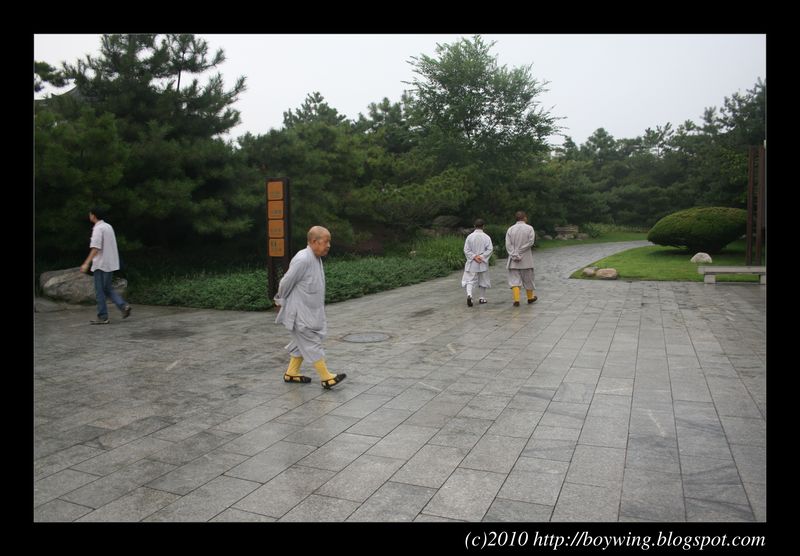
Some of the monks strolling around.

I could imagine myself living in a summer house just like this one.

A couple of local girls.

A famous Chinese monk who taught the Japanese how to write with the Chinese characters. He also taught them about a lot else from the Chinese culture and made them civilised so they didn't have to live in caves any more.

I can never get enough of the cool Asian roofs.

A monk reading from the holy scripture near a Buddha altar.

2009-03-12

If programming languages were...

As a computer programming nerd you often find yourself amused with smart jokes about nerdy stuff like programming and other things like that. So when I the other day got an email with a link where they compare different famous programming languages with religion I can not help to read it and smile approvingly.


If programming languages were cars...
  • Ada is a tank. A butt-ugly tank that never breaks down. People laugh uncontrollably if you tell them you drive Ada, but really, do you want to be driving a sports car in a war zone?

  • Assembly Language is a bare engine; you have to build the car yourself and manually supply it with gas while it's running, but if you're careful it can go like a bat out of hell.

  • Basic is a simple car useful for short drives to the local shops. Once popular with learner drivers, it has recently been stripped down to a shell and rebuilt by a major manufacturer, The new version has been refurbished for longer journeys, leaving only cosmetic similarities to the original model.

  • C is a racing car that goes incredibly fast but breaks down every fifty miles.

  • Cobol is reputed to be a car, but no self-respecting driver will ever admit having driven one.

  • C# is a competing model of family station wagons. Once you use this, you're never allowed to use the competitors' products again.

  • C++ is a souped-up version of the C racing car with dozens of extra features that only breaks down every 250 miles, but when it does, nobody can figure out what went wrong.

  • Eiffel is a car that includes a built-in driving instructor with a French accent. He will help you quickly identify and learn from your mistakes, but don't you dare argue with him or he'll insult you and throw you out of the car.

  • Erlang is a fleet of cars that all cooperate to get you where you want to go. It takes practice to be able to drive with one foot in each of several cars, but once you learn how you can drive over terrain that would be very hard to navigate any other way. In addition, because you're using so many cars, it doesn't matter if a few of them break down.

  • Forth is a car you build yourself from a kit. Your car doesn't have to look or behave like anyone else's car. However, a Forth car will only go backwards. FORTH LOVE IF HONK THEN !

  • Fortran is a pretty primitive car; it'll go very quickly as long as you are only going along roads that are perfectly straight. It is believed that learning to drive a Fortran car makes it impossible to learn to drive any other model.

  • Java is a family station wagon. It's easy to drive, it's not too fast, and you can't hurt yourself.

  • Haskell is an incredibly elegantly-designed and beautiful car, which is rumored to be able to drive over extremely strange terrain. The one time you tried to drive it, it didn't actually drive along the road; instead, it made copies of itself and the road, with each successive copy of the road having the car a little further along. It's supposed to be possible to drive it in a more conventional way, but you don't know enough math to figure out how.

  • Lisp looks like a car, but with enough tweaking you can turn it into a pretty effective airplane or submarine.

  • Mathematica is a well-designed car that borrowed a lot from the Lisp car without giving it nearly the credit it deserved. It can solve equations to determine the most efficient way to get to the destination, but it costs a fortune

  • Matlab is a car designed for novice drivers going on short trips over terrain similar to the terrain the Mathematica car is usually driven over. It is very comfortable when driving over this terrain, but if you go off the trail even a little the car becomes so hard to drive that more snobby drivers refuse to even acknowledge that it's a car.

  • Ocaml is a very sexy European car. It's not quite as fast as C, but it never breaks down, so you end up going further in less time. However, because it's French, none of the controls are in the usual places.

  • Perl is supposed to be a pretty cool car, but the driver's manual is incomprehensible. Also, even if you can figure out how to drive a Perl car, you won't be able to drive anyone else's.

  • PHP is the Oscar Mayer Wienermobile, it's bizarre and hard to handle but everybody still wants to drive it.

  • Prolog is fully automatic: you tell it what your destination looks like, and it does all the driving for you. However, the effort required to specify most destinations is equivalent to the effort of driving there.

  • Python is a great beginner's car; you can drive it without a license. Unless you want to drive really fast or on really treacherous terrain, you may never need another car.

  • Ruby is a car that was formed when the Perl, Python and Smalltalk cars were involved in a three-way collision. A Japanese mechanic found the pieces and put together a car which many drivers think is better than the sum of the parts. Other drivers, however, grumble that a lot of the controls of the Ruby car have been duplicated or triplicated, with some of the duplicate controls doing slightly different things in odd circumstances, making the car harder to drive than it ought to be. A redesign is rumored to be in the works.

  • Smalltalk is a small car originally designed for people who were just learning to drive, but it was designed so well that even experienced drivers enjoy riding in it. It doesn't drive very fast, but you can take apart any part of it and change it to make it more like what you wanted it to be. One oddity is that you don't actually drive it; you send it a message asking it to go somewhere and it either does or tells you that it didn't understand what you were asking.

  • Visual Basic is a car that drives you.


If programming languages were religions...
  • C would be Judaism - it's old and restrictive, but most of the world is familiar with its laws and respects them. The catch is, you can't convert into it - you're either into it from the start, or you will think that it's insanity. Also, when things go wrong, many people are willing to blame the problems of the world on it.
  • Java would be Fundamentalist Christianity - it's theoretically based on C, but it voids so many of the old laws that it doesn't feel like the original at all. Instead, it adds its own set of rigid rules, which its followers believe to be far superior to the original. Not only are they certain that it's the best language in the world, but they're willing to burn those who disagree at the stake.

  • PHP would be Cafeteria Christianity - Fights with Java for the web market. It draws a few concepts from C and Java, but only those that it really likes. Maybe it's not as coherent as other languages, but at least it leaves you with much more freedom and ostensibly keeps the core idea of the whole thing. Also, the whole concept of "goto hell" was abandoned.

  • C++ would be Islam - It takes C and not only keeps all its laws, but adds a very complex new set of laws on top of it. It's so versatile that it can be used to be the foundation of anything, from great atrocities to beautiful works of art. Its followers are convinced that it is the ultimate universal language, and may be angered by those who disagree. Also, if you insult it or its founder, you'll probably be threatened with death by more radical followers.

  • C# would be Mormonism - At first glance, it's the same as Java, but at a closer look you realize that it's controlled by a single corporation (which many Java followers believe to be evil), and that many theological concepts are quite different. You suspect that it'd probably be nice, if only all the followers of Java wouldn't discriminate so much against you for following it.

  • Lisp would be Zen Buddhism - There is no syntax, there is no centralization of dogma, there are no deities to worship. The entire universe is there at your reach - if only you are enlightened enough to grasp it. Some say that it's not a language at all; others say that it's the only language that makes sense.

  • Haskell would be Taoism - It is so different from other languages that many people don't understand how can anyone use it to produce anything useful. Its followers believe that it's the true path to wisdom, but that wisdom is beyond the grasp of most mortals.

  • Erlang would be Hinduism - It's another strange language that doesn't look like it could be used for anything, but unlike most other modern languages, it's built around the concept of multiple simultaneous deities.

  • Perl would be Voodoo - An incomprehensible series of arcane incantations that involve the blood of goats and permanently corrupt your soul. Often used when your boss requires you to do an urgent task at 21:00 on friday night.

  • Lua would be Wicca - A pantheistic language that can easily be adapted for different cultures and locations. Its code is very liberal, and allows for the use of techniques that might be described as magical by those used to more traditional languages. It has a strong connection to the moon.

  • Ruby would be Neo-Paganism - A mixture of different languages and ideas that was beaten together into something that might be identified as a language. Its adherents are growing fast, and although most people look at them suspiciously, they are mostly well-meaning people with no intention of harming anyone.

  • Python would be Humanism: It's simple, unrestrictive, and all you need to follow it is common sense. Many of the followers claim to feel relieved from all the burden imposed by other languages, and that they have rediscovered the joy of programming. There are some who say that it is a form of pseudo-code.

  • COBOL would be Ancient Paganism - There was once a time when it ruled over a vast region and was important, but nowadays it's almost dead, for the good of us all. Although many were scarred by the rituals demanded by its deities, there are some who insist on keeping it alive even today.

  • APL would be Scientology - There are many people who claim to follow it, but you've always suspected that it's a huge and elaborate prank that got out of control.

  • LOLCODE would be Pastafarianism - An esoteric, Internet-born belief that nobody really takes seriously, despite all the efforts to develop and spread it.

  • Visual Basic would be Satanism - Except that you don't REALLY need to sell your soul to be a Satanist...

2009-01-22

Do not get drunk on wine

"Do not get drunk on wine, which leads to debauchery.
Instead, be filled with spirits."
(Ephesians 5:18)

2008-12-09

Jing'an Temple

Today we went to the Jing'an temple in the middle of a fancy commercial area in Shanghai. As you walk down the street it is hard to imagine that you are on your way to an ancient looking temple. We see expensive brand stores like Marc Jacobs and luxurious hotels. We see businessmen and young stylish kids. None of them giving the impression or feeling that we are getting closer to a Buddhist temple. There are sky scrapes everywhere and new ones are being built even higher. I almost started to wonder if Girlwing knew the right direction or if we were about to getting lost. But suddenly... there it is standing between the expensive mall and the sky scrapes.

You can see the temple here in the middle of the picture below. It is the houses with the ancient Chinese roofs. All around you see the sky scrapes and the x-mas decorated malls.


So what do you do in a Chinese temple? As a tourist you walk around and look at all the interesting details and try to take pictures without disturbing the local people or the gods. As a more or less true believer you will probably do the following...

Light some incense

When it burns you can blow out the flames and the aromatic smoke will get produced.

Bow three times to the north, east, south and west

Then leave your incense...

...in the beautiful "ash tray"...

...for others to enjoy.

Then you can throw coins in this "thing" and hope for some blessing or luck. If you are able to throw the coin up on one of the small roofs you will be more lucky. The higher you get the more blessed you will be.

Then we meet the fat and happy Buddha...

...and the rest of the gods...

...to whom you pray. You pray to different gods depending on what you want to achieve. The gods have different roles in life. You pray to one god for health and another one for a good hunting and another one for good results in a weiqi tournament.

It is an active temple with a bunch of monks

The temple is a collection of beautiful ancient style buildings

This is the newest building still in construction

In most of the buildings there are big rooms like this one with a different good statue in each. This is Guanyin.

Everywhere we pray to a lot of goods

A beautiful detail on a pole outside the temple. Probably not related.